Gold Bottom Now Confirmed
Readers would do well to follow the trail of comments, especially January 28, May 2, June 9, June 18, and the latest July 7.
A compressed compendium of comments would inform you that we were looking for gold to correct from its lofty highs, earlier in the year. Gold needed to correct, wash out the speculative excesses, find and defend a bottom, and start turning momentum and sentiment positive.
We have been waiting for gold to complete a sequence typical of markets in correction. The market swings from overbought in both momentum and sentiment, to oversold in momentum and sentiment.
Divergences usually emerge. That means price continues to fall, but momentum indicators do not, and hence “the divergence.”
On June 9th, we provided a partial “bottom confirmation checklist” for you to follow. Most were satisfied.
We suggested that a low in June was highly likely, and the subtle price changes would start to turn positive after July 4th.
As the chart below shows, we could not have called much closer if we had the actual script for the play.
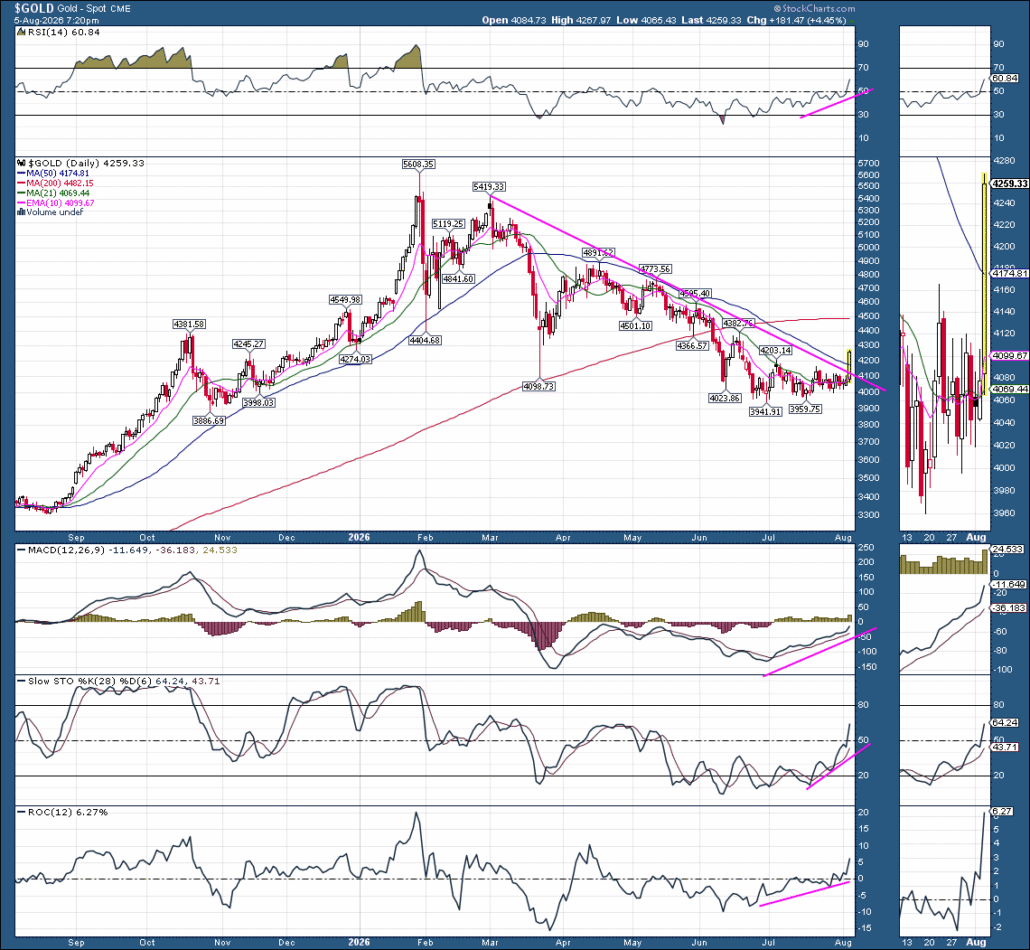
The market reached the most recent low on June 30; we are now a little more than 7% off that low.
Gold mining shares, as measured by GDX, are now up about 20% from the recent low.
Until July 7, we did not think we were “there yet” in terms of a strong opinion on a bottom, but in our last report we suggested the preponderance of evidence supported the notion a bottom was in. We wanted more things to confirm, but noted you can’t wait for everything to line up because that usually occurs well off the bottom.
However, we did not get everything right. We thought gold mining shares would lead the market off the bottom. They did not, but as of this writing, they are outperforming bullion once bullion took the lead.
The market was able to defend roughly $4,000 per ounce, and things started to turn better by mid-July, with lows being defended and the market actually putting in one of our remaining requirements, a series of rising bottoms. We also have generated point-and-figure buy signals on both shares and bullion, and bullion has taken out its bear market linear trendline formed from the peak in late January.
Shorter-term moving averages have turned upward, actual buy signals have been added to reversal signals, and we remain very close timewise to the actual low, with technical market conditions rapidly improving.
We are aware that most readers get lost in our technical jargon, although our conclusion hopefully was clear. But it was the technicals that told us we were first in trouble after the sharp run-up, and it was the technicals that gave the first good indication of the bottom forming.
However, the best calls come when the stars align, and technicals and fundamentals become clearer and support each other.
It is to some of these fundamentals for gold that we now would like to turn.
For markets, there is nothing quite as influential as supply and demand data.
Gold supply is fairly stable, with small increases in primary production and variations in scrap recovery. Over the past 12 months, supplies have increased a paltry 1%. A slight gain in primary production was offset by a 6% drop in recycling.
Demand has been down, especially in Western markets. Flows out of global bullion ETFs have been negative and have been positive only in the Far East market, as Western investors continued to liquidate.
As with bullion ETFs, American investors have been big sellers of gold mining shares. Consequently, gold mining shares declined almost 40% from the March highs.
Gold coin sales have also declined sharply. The US Mint reports sales of US-minted coins are down 55% since 2024, with declines extending into this year as well.
Gold futures positions for bullion have dropped to the lowest level in 13 years, and even in Asia, where gold demand has been stronger, positions on the Shanghai Exchange are 45% down from the recent peak. Speculators are seeking their fortune elsewhere.
This fundamental data confirms what the technicals were saying. The public is out. Remember, markets bottom on fear, rise on expectation, and peak on euphoria.
Moreover, the pattern shows robust demand only coming from central banks, which buy gold and then hold it as a reserve. In short, the dumb money has been a big seller and the smart money has been a big buyer.
Central bank buying continues to rise, even though central bank data has been subdued because banks have been underreporting their purchases. The World Gold Council’s recent survey indicated that 89% of central banks felt gold reserves would rise over the next year, and 45% of banks reported they would be expecting to increase their holdings.
In the second quarter of 2026, central bank purchases surged to 289 tons, up 62% year over year!
Besides the supply and demand data, the US dollar has stalled repeatedly at around 100 on the DXY index, and fiscal deficits continue to accelerate at a frightful pace. Fiscal cumulative deficits through June remain high, in the $1.3 trillion range, despite good tax revenue growth.
We are not “growing out” of our fiscal deficit crisis, and one can only wonder what the numbers would look like if we had a recession.
Many are concerned about the sharp rise in interest rates. True, the FED has not increased them, but the changes are nonetheless in the marketplace due to natural forces.
Given all nations and companies are much more indebted now than in the past, worries are that a continued rise in rates will “break something” in the system.
The key 10-year Treasury rate recently hit 4.6%, and the 30-year hit 5.2%. Looking back in history, the last time both yields reached this level over a two-year period was 2006-2007.
We would remind you this was just before the 2008 crash and what is now called the Great Financial Crisis. Fears about something “breaking” are not irrational.
Such financial stress may come from overleveraged private equity or corporations. But it also may come from outside in the form of a foreign debt crisis.
For example, Japanese interest rates have been soaring and are now at the highest level in 30 years. You would think higher rates would attract money to the Yen, but the Yen has dropped 8% over the past year.
Just recently, Treasury Secretary Bessent activated a little-used facility used during the Covid crisis to try to support the Yen.
Such travails for the world’s third-largest GDP can have serious consequences. In short, when something breaks in the system, it may look different than 2008.
Meanwhile, the Trump Administration has requested over a 40% increase in defense spending, a request unlikely to make the deficit crisis get any better. Such increases are necessary, but they come with the backdrop of unrestrained social spending. Fiscal prudence plays no role with either political party.
Markets don’t see any easy way out of this because there is no easy way out. Historically, austerity does not sell politically, so likely more currency debasement will occur.
This is a very important fundamental for gold inasmuch as most “advanced” countries in Western Europe and Japan have even more welfare spending and socialistic hobbles placed on their economies than ours. They also have worse demographics. Hence, there is no “strong” currency to flee to, except gold.
Maybe central banks are not trying to replace the dollar; they are just trying to reduce their reliance on the dollar and the weaponized international payments system.
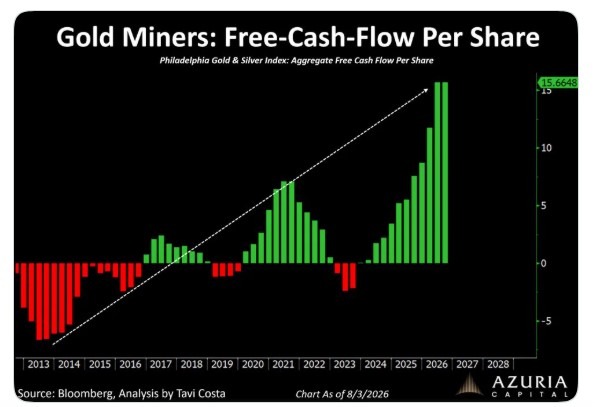
For the gold shares, if they can keep their expenses fairly even and sell their product, gold bullion, at an increased price, their profit margin and free cash flow expand.
Free cash flow is what is left after a company pays to support all of its operating costs. It is a wonderful thing as it allows for: debt reduction, capital acquisitions, share buybacks, increased dividends to investors, and building up cash reserves. Below is a chart of free cash flow from Tavi Costa for the gold mining industry. In a word, it is outstanding and accelerating.
We continue to think investors so inclined should enter the market near this low as we expect prices to improve, albeit chaotically, and still expect the second half of the year to be much better for the metals complex.
Not everyone should invest in gold, or gold-related equities, but given world conditions, we can’t see why anyone would not want at least an insurance position in the metal.
-Neil Nobel
*****
Neland ‘Neil’ Nobel was born in Uniontown, Pennsylvania, and moved to Arizona in 1961. He attended ASU and earned a B.A. and an M.A. in history, with a specialty in economic and military history. He graduated Summa Cum Laude and received a Richard M. Weaver Fellowship from the Intercollegiate Studies Institute. He spent the next 45 years in the financial services industry, ending his career with a 25-year run with UBS as a portfolio manager and Certified Financial Planner. In retirement, he remains active, having founded the Prickly Pear in 2020 and continuing to contribute content. In his spare time, he is a certified firearms instructor and runs a hiking club and two shooting clubs. He is married with three children and three grandchildren.
The author’s views are their own and do not constitute financial, investment, or legal advice. Investing involves risk; please consult with a qualified professional before making any financial decisions.
*****
Charts courtesy of Stockcharts.com. All facts and data are derived from sources believed to be reliable, but their accuracy is not guaranteed. Consult with a qualified financial planner or do your own research. This is not an offer to buy or sell securities and is offered solely for public education.