The Paper Straw Audit: 5 Stats to Shred Straw Virtue Signaling
The paper straw has become the ultimate symbol of “luxury beliefs”—policies that make the affluent feel virtuous while imposing a functional and economic tax on everyone else.
The danger of the paper straw mandate isn’t about the straw; it’s about the precedent of psychological submission. When a small group of activists can force 330 million people to use a product that is objectively worse, more toxic, and more energy-intensive, they aren’t saving the planet—they are testing your compliance.
Let us get back to the common-sense facts:
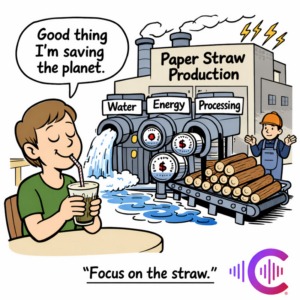
- The Structurally Inferior Tax: Because paper straws dissolve mid-drink, consumers frequently use two or three per beverage; this effectively doubles the manufacturing carbon footprint while forcing small business owners to pay more for a product that fails to perform.
- The Health Intervention: To prevent them from turning into mush, 90% of paper straws are treated with “forever chemicals” (PFAS); activists have traded a manageable waste-stream issue for a direct health risk, leaching industrial chemicals into consumers’ bodies.
- The Global Distraction: Plastic straws account for a mere 0.02% of plastic waste entering the global oceans; by targeting a tiny, visible consumer product, regulators avoid the difficult conversation regarding the 46% of Great Pacific Garbage Patch waste that actually comes from foreign commercial fishing nets.
Standout Stat: > 90% of all paper straws tested in a major 2023 study contained PFAS (forever chemicals), compared to only 75% of plastic straws.
- Carbon Laundering: Manufacturing paper straws requires significantly more energy and water than producing plastic ones; this shifts the environmental cost to the manufacturing stage to claim a “win” at the disposal stage, undermining American energy efficiency for a net-zero gain.
- The Water Waste: Manufacturing paper alternatives is an incredibly thirsty process, requiring 10 to 100 times more water than plastic production. In a world of “sustainability” concerns, the math simply doesn’t add up.
At the end of the day, a government that tells you how to sip your soda while ignoring 50,000 tons of industrial fishing gear in the Pacific isn’t interested in the environment—it’s interested in one word–control.
“The urge to save humanity is almost always only a false-face for the urge to rule it.” — H.L. Mencken
-The Editors